New translator looking for career advice. Autor wątku: Ingrid Diniz
|
|---|
Hello, I am writing this because I would like to have a piece of advice and also to connect with all of you, if that is possible.
Before anything else, let me introduce myself.
My name is Ingrid and I'm from Brazil. I speak Portuguese, English and I understand a little bit of Spanish too.
I am new to the translation field. I hold a bachelor's degree in Pedagogy and another in Languages. I recently enrolled in a postgraduation course in translation, in order to b... See more Hello, I am writing this because I would like to have a piece of advice and also to connect with all of you, if that is possible.
Before anything else, let me introduce myself.
My name is Ingrid and I'm from Brazil. I speak Portuguese, English and I understand a little bit of Spanish too.
I am new to the translation field. I hold a bachelor's degree in Pedagogy and another in Languages. I recently enrolled in a postgraduation course in translation, in order to become a professional translator.
What would you recommend to me? Where should I start? How did you get your first translation job here and how many days were necessary to get it? Was it on the first try or not?
When you were doing your fisrt translation, how long did it take to get it done?
Feel free to share your experience with me or add any information that may be worth sharing to help me.
I would love to see how it has started for each of you.
 ▲ Collapse
| | | |
Find another career. If you choose translation, you have nothing but frustration (and penury) in front of you.
| | | |
Ingrid Diniz wrote:
What would you recommend to me? Where should I start? How did you get your first translation job here and how many days were necessary to get it? Was it on the first try or not?
When you were doing your fisrt translation, how long did it take to get it done?
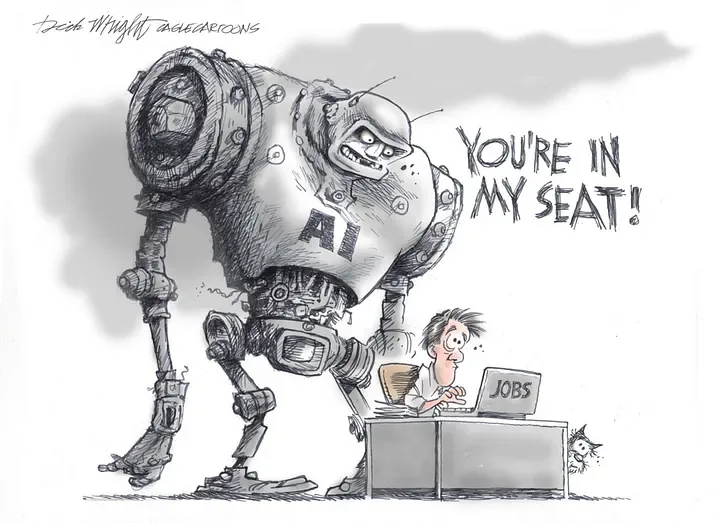
All of this is irrelevant in light of what the field of translation has become. The best advice I can give to aspiring translators is don’t do it. Translation was great when I started, that is no longer the case. Sorry. Thank AI.
| | | |
I advise you to run from it while you can...
| | |
|
|
|
Daryo
Local time: 09:41
serbski > angielski
+ ...
| Do you really want to board a sinking ship | Jul 24 |
where half of the crew is busy unplugging the holes in the hull?
If you chose translating because you really like it, do it as a hobby - translate what you like when you like and if you make any money out of it consider it as a bonus.
But for the 'day job' better look for something else. There still are professions where real people are badly needed and where being bilingual is, if not a requirement, certainly a huge advantage. I don't know what's exactly the sit... See more where half of the crew is busy unplugging the holes in the hull?
If you chose translating because you really like it, do it as a hobby - translate what you like when you like and if you make any money out of it consider it as a bonus.
But for the 'day job' better look for something else. There still are professions where real people are badly needed and where being bilingual is, if not a requirement, certainly a huge advantage. I don't know what's exactly the situation in Brazil, but if you start looking with an open mind you'll find them.
As Michele Fauble said, decades ago translating was a great job - especially when you're lucky to be in high demand in your 'local market'. Hardly likely to happen NOW with your language pair - unless you are extremely lucky to find some very specialised niche market. The operative word being 'extremely lucky' ...
Only being realistic. ▲ Collapse
| | | | Li-Hsiang Hsu 
Francja
Local time: 10:41
francuski > chiński
+ ...
| Treat languages as a passion, not a profession. | Jul 25 |
That's it.
| | | | Gregor Trebec
Słowenia
Local time: 10:41
angielski > słoweński
+ ...
I am not an expert but i came to think many here want to translate via the web, the internet. But the web cannot bring you steady income. Never did. At least where i come from. The buiseness still goes in the real world therefore look for clients 'outside' the computer.
| | | |
Ingrid Diniz wrote:
I am new to the translation field. I hold a bachelor's degree in Pedagogy and another in Languages. I recently enrolled in a postgraduation course in translation, in order to become a professional translator.
I don't want to discourage you, but I also don't want to give you unrealistic expectations.
The translation industry has changed dramatically in recent years. Many experienced translators with 15, 20 or even 30 years of experience are facing reduced workloads, lower rates and increasing competition from AI mainly. Building a freelance translation career today is considerably more challenging than it was a decade ago.
Since you already have a degree in Pedagogy, I would encourage you not to overlook this qualification. It may offer you greater stability and opportunities, and your translation training can still be valuable in the classroom. Translation is an excellent teaching tool and can help students develop vocabulary, grammar, reading comprehension, writing skills, cultural awareness and critical thinking.
I would also add one point about training. A postgraduate course in translation is undoubtedly worthwhile, but it is a specialisation, not a substitute for years of professional practice.
Likewise, having a degree in translation does not automatically make someone a good translator.
Translation is much more than knowing languages or mastering CAT tools. It requires excellent writing skills in your native language, strong research skills, sound judgement, subject-matter knowledge, cultural awareness, curiosity, consistency, and the ability to solve problems and make informed decisions. Those are skills that develop gradually through experience.
I wish you every success.
| | |
|
|
|
that won't be replaced by an IA bot for the foreseeable future. Preferably a manual trade.
| | | | Samuel Murray
Holandia
Local time: 10:41
Członek ProZ.com
od 2006
angielski > afrikaans
+ ...
Ingrid Diniz wrote:
What would you recommend to me?
My advice to you is the same as my advice to all new translators, despite the fact that the industry has changed dramatically and it's now 100x more difficult to break into translation.
You have to find clients, and the quickest way to find clients is to work for translation agencies*. So, visit the ProZ.com Blue Board, filter according to which agencies you would want to work for (e.g. agencies with a high rating, agencies in your preferred countries), visit their websites and apply to them or email them to market yourself to them. Also sign up with the top 400 or so translation companies on ProZ.com's company list.
https://www.proz.com/blueboard
https://www.proz.com/business
You can expect 1-2% of them to respond, and you can expect work from 1-2% of those that respond. So this is a numbers game: get yourself listed on the books of as many agencies as you can.
How did you get your first translation job here and how many days were necessary to get it?
When I studied translation, I was told by my professors that it takes 6-12 months for a translator to get enough clients to have sufficient income to sustain them. Of course, this was before the interwebs, but it still sounds like a good warning: initially, you will struggle a lot to get any work.
Was it on the first try or not?
I'm not sure what you mean by "first try" (-:
When you were doing your first translation, how long did it take to get it done?
My very first translation took 2 weeks to complete. But with agencies you're likely to get a lot of jobs that you can finish in an hour or two, and they'll likely expect you to deliver it within a day or two.
* The translation agency is your client.
[Edited at 2026-07-28 09:08 GMT]
| | | | Mario Chávez
USA
Local time: 04:41
angielski > hiszpański
+ ...
| So many questions… | Jul 29 |
…and so few answers.
Hola, Ingrid,
Most of your questions will be answered in your first experience in the translation profession: approach more experienced translators where they congregate locally: do they have an association, a club? Go there and introduce yourself, and ask these questions there.
Forge relationships with your local peers, other translation students, translation company owners. Listen to them all.
Your questions will gradua... See more …and so few answers.
Hola, Ingrid,
Most of your questions will be answered in your first experience in the translation profession: approach more experienced translators where they congregate locally: do they have an association, a club? Go there and introduce yourself, and ask these questions there.
Forge relationships with your local peers, other translation students, translation company owners. Listen to them all.
Your questions will gradually find answers.
Mario Chávez
Ingrid Diniz wrote:
Hello, I am writing this because I would like to have a piece of advice and also to connect with all of you, if that is possible.
Before anything else, let me introduce myself.
My name is Ingrid and I'm from Brazil. I speak Portuguese, English and I understand a little bit of Spanish too.
I am new to the translation field. I hold a bachelor's degree in Pedagogy and another in Languages. I recently enrolled in a postgraduation course in translation, in order to become a professional translator.
What would you recommend to me? Where should I start? How did you get your first translation job here and how many days were necessary to get it? Was it on the first try or not?
When you were doing your fisrt translation, how long did it take to get it done?
Feel free to share your experience with me or add any information that may be worth sharing to help me.
I would love to see how it has started for each of you.
▲ Collapse
| | | | Mario Chávez
USA
Local time: 04:41
angielski > hiszpański
+ ...
| Some do, some don't | Jul 29 |
It may so well be that frustration and penury are the fruits of the labors of some translators, but not all. Not even close.
My suggestion to Ingrid applies in your case as well.
Mario Chávez
Michael Newton wrote:
Find another career. If you choose translation, you have nothing but frustration (and penury) in front of you.
| | |
|
|
|
Daryo
Local time: 09:41
serbski > angielski
+ ...
| x100 times vs x5 - 10 times? | Jul 29 |
Samuel Murray wrote:
Ingrid Diniz wrote:
What would you recommend to me?
My advice to you is the same as my advice to all new translators, despite the fact that the industry has changed dramatically and it's now 100x more difficult to break into translation.
You have to find clients, and the quickest way to find clients is to work for translation agencies*. So, visit the ProZ.com Blue Board, filter according to which agencies you would want to work for (e.g. agencies with a high rating, agencies in your preferred countries), visit their websites and apply to them or email them to market yourself to them. Also sign up with the top 400 or so translation companies on ProZ.com's company list.
https://www.proz.com/blueboard
https://www.proz.com/business
You can expect 1-2% of them to respond, and you can expect work from 1-2% of those that respond. So this is a numbers game: get yourself listed on the books of as many agencies as you can.
How did you get your first translation job here and how many days were necessary to get it?
When I studied translation, I was told by my professors that it takes 6-12 months for a translator to get enough clients to have sufficient income to sustain them. Of course, this was before the interwebs, but it still sounds like a good warning: initially, you will struggle a lot to get any work.
Was it on the first try or not?
I'm not sure what you mean by "first try" (-:
When you were doing your first translation, how long did it take to get it done?
My very first translation took 2 weeks to complete. But with agencies you're likely to get a lot of jobs that you can finish in an hour or two, and they'll likely expect you to deliver it within a day or two.
* The translation agency is your client. [Edited at 2026-07-28 09:08 GMT]
Of course, if you really persist you'll eventually find 'work in linguistic services' even if it's '100 times more difficult than it used to be'. Which part of it would warrant the label 'translation' is another matter.
The real question being: is it worth getting into it as of now?
Also, more importantly: which way the 'state of the market' is likely to evolve in the next few years, never mind a decade of two?
Do you want to find yourself in a profession going downhill fast for the vast majority of still remaining practitioners and trapped in it by the sunk cost fallacy?
It's not that the 'direction of travel' is difficult to see. Some saw it already years ago:
There's no future in translation 2008-08-02
I am a student specialised in translation and this is exactly the type of evolution in the tranlation's sphere that pushes me not to keep on getting specialised in that profession.
***I see that prices are low*** and that the biggest translation agencies now gather to have even more power concerning prices over translators.
What can we do against such things? An easy answer: nothing!
Translation was something I dreamed about when I was younger. Next week I'll turn 25 and I know that my professional future does not belong to translation anymore.
https://www.proz.com/forum/prozcom_translator_coop/110929-clients_large_translation_companies_now_talking_about_pooling_linguistic_data_should_we_be_there-page8.html#:~:text=There's%20no%20future,to%20translation%20anymore.
Notice the year: 2008!
Anyone claiming that anything has improved since?
As or the year 2026, easy to check it for yourself: just take a look in the Jobs section (and in few other sites) at what is on offer right now in your langue pair, and take into account that in few years time even these will be looking as 'damn good offers' [unless there is some miraculous reversal in the trend]. Does it look attractive enough to neglect other better possibilities that are 'only' 5 - 10 times more difficult to get into compared to before?
BTW if you decide to persist, agencies are 'the least bad option / the solution of last resort'. Better to aim from the start for direct clients (i.e. the ones who need your translations for themselves, as opposed to self-serving intermediaries) - takes more efforts (to put luck on your side…) and time but it's definitely worth it.
| | | | To report site rules violations or get help, contact a site moderator: You can also contact site staff by submitting a support request » New translator looking for career advice. | Pastey | Your smart companion app
Pastey is an innovative desktop application that bridges the gap between human expertise and artificial intelligence. With intuitive keyboard shortcuts, Pastey transforms your source text into AI-powered draft translations.
Find out more » |
| | Trados Business Manager Lite | Create customer quotes and invoices from within Trados Studio
Trados Business Manager Lite helps to simplify and speed up some of the daily tasks, such as invoicing and reporting, associated with running your freelance translation business.
More info » |
|
| | | | X Sign in to your ProZ.com account... | | | | | |


































 Login to reply/comment
  Translation news
